Which neighbourhoods make sense for buy-to-let in 2026, yield trade-offs, capital growth, and the regulatory backdrop.
All guidesWorthing splits into three reasonably distinct lettings markets — and they suit three different strategies. Worthing town centre and the seafront (BN11) is the highest-yielding part of the coast. One- and two-bed flats around the station and Montague Street regularly let for £900–£1,400 pcm on purchase prices that still start in the £200,000s for the right unit. Strong demand from professional couples, NHS staff at Worthing Hospital, and remote workers commuting infrequently to London. Gross yields of 5.5–6.5% are routine; net yields around 4–4.5% after professional management. Capital growth has been modest over the past decade but the income story is consistent. Goring (BN12) is the family end. Three- and four-bedroom semi-detached houses with gardens — typical purchase price £450,000–£600,000, typical rent £1,800–£2,400 pcm. Yields are lower (around 4%) but tenants stay longer, voids are rare, and the maintenance profile is straightforward. Goring also benefits from its own station and the catchment for several well-regarded primary schools — both of which keep demand high. Tarring sits between the two. Victorian terraces in walking distance of the town centre and the station, three-bed houses for £400,000–£500,000, rents £1,600–£2,000. The most balanced of the three for a long-term buy-to-let — solid yield, slow but reliable capital growth, the kind of tenant who renews quietly for five years. If you're buying for income, BN11 flats. If you're buying for the easiest possible portfolio addition, Goring houses. If you're buying for the long hold with one eye on selling to a family in fifteen years, Tarring.
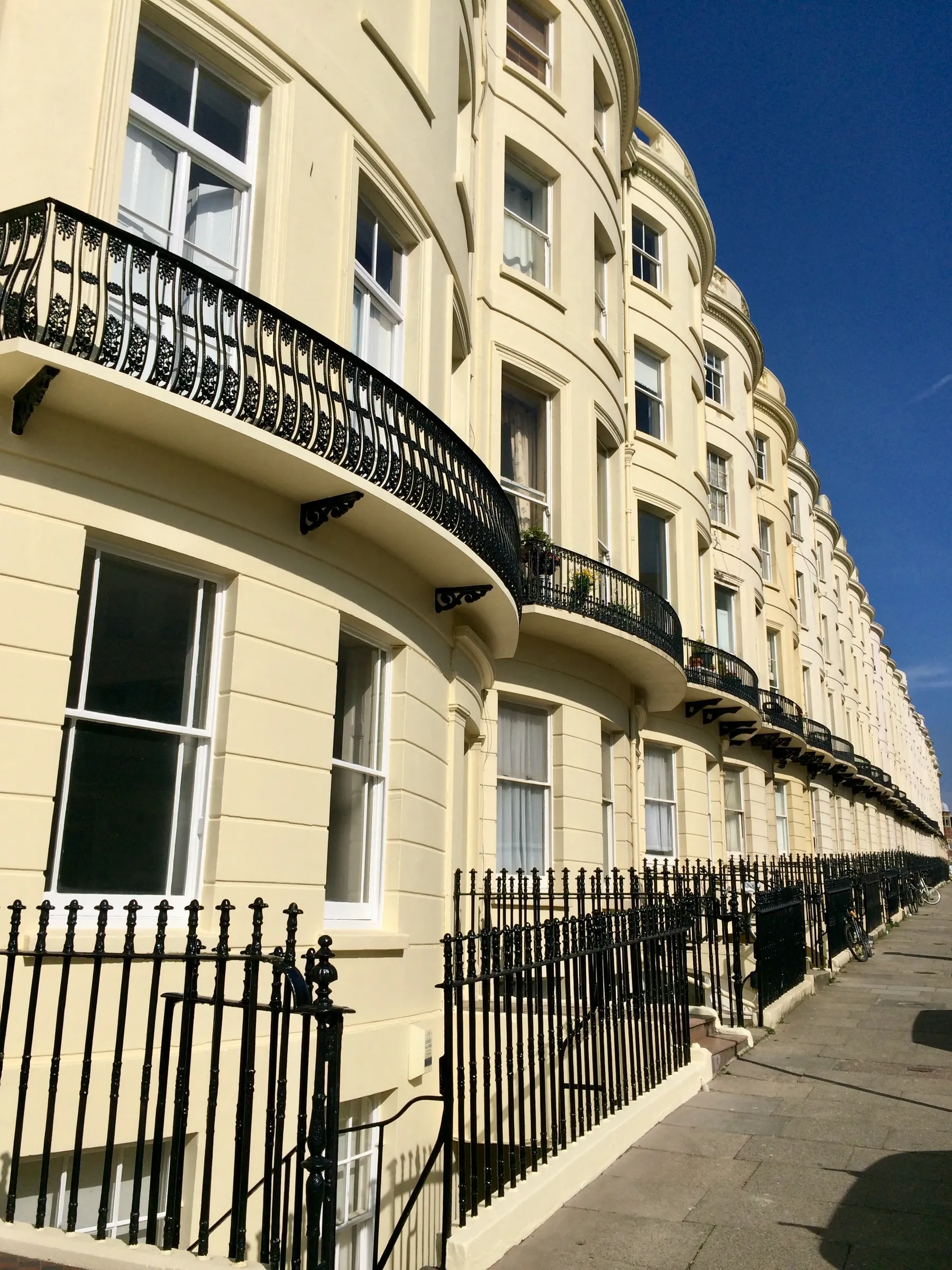
Brighton and Hove are three markets, not one. BN1 covers central Brighton north of the seafront and up through Preston Park, Fiveways, and Withdean. Demand is broad — students, young professionals, families in the north of the postcode. Two-bed Victorian conversions around Seven Dials let for £1,600–£2,000 pcm against purchase prices in the £350,000–£450,000 range. Yields 4–5%, with the strongest capital growth on the coast historically. The north of BN1 (Preston Park, Patcham) skews more family and quieter. BN2 is east of the centre — Kemptown, Hanover, the lanes around the racecourse. Stronger flat market, more LGBT+ and younger-professional demand, and a meaningful student presence supporting HMOs in some streets. Yields broadly similar to BN1; the trade-off is more turnover. Worth knowing: parts of BN2 are inside the Article 4 direction that restricts new HMO conversions (see next section). BN3 is Hove. Period flats in Brunswick and the central conservation area let to professional couples and families who want Brighton without the centre's intensity. Three- and four-bed houses in central Hove are now £600,000+ purchase / £2,200–£2,800 pcm — yields under 4%, but the capital growth on prime Hove stock has consistently outperformed everywhere else on the coast over twenty-year horizons. The student strategy works in pockets of BN1 and BN2 (Lewes Road corridor, Coombe Road, parts of Hanover) — gross yields can push above 7% per room — but the regulatory load is heavy (mandatory HMO licensing, Article 4 in much of the city, additional licensing in BN1 and BN2). It's a separate business, not a more profitable version of the same one.
Article 4 directions remove the permitted-development right to convert a family home into a small HMO (3–6 unrelated occupants) — meaning you need full planning permission, which is granted sparingly. Brighton & Hove has had a city-wide Article 4 direction in force since 2013. To convert any family home into an HMO anywhere in the city you need planning permission, and the council has a policy of refusing applications in wards where the existing HMO concentration is above 10% of housing stock — which is most of central Brighton, much of BN1, and significant parts of BN2. Worthing's Article 4 position is more limited. There is no town-wide direction, but there are localised areas where HMO conversions are restricted. [VERIFY: current Worthing Article 4 footprint — check Adur & Worthing Councils' planning portal for the live map and any 2025/26 extensions.] Check before exchanging on any property you'd intend to convert. What this means in practice: if your strategy is to buy a family home and let it as a four-person professional house-share, do not buy without confirming the Article 4 status. A property bought on the assumption of an HMO conversion that then can't get planning is materially less valuable. Properties that already have planning consent and an HMO licence in place are correspondingly more valuable — and listings of those are usually marketed with the licence shown. For mandatory HMO licensing (5+ unrelated occupants regardless of property size, or 3+ in some local additional schemes), check your local authority's licensing register before completion. Letting an unlicensed HMO is a criminal offence with civil penalties up to £30,000.
A second residential property attracts the standard Stamp Duty bands plus the Additional Property Surcharge. The surcharge was increased to 5 per cent from 31 October 2024, up from the 3 per cent rate that had applied since 2016. In practical terms, the 2026 bands for a residential purchase by someone who already owns a home work out like this. Anything up to £125,000 is taxed at 5 per cent (zero per cent standard plus the 5 per cent surcharge). The slice from £125,001 to £250,000 is taxed at 7 per cent. From there up to £925,000 it's 10 per cent. From £925,001 to £1.5 million it's 15 per cent. Above £1.5 million the rate is 17 per cent. The cash impact is meaningful. A £350,000 Brighton flat carries £21,250 of stamp duty — a substantial chunk of the acquisition cost that has to come from cash, not the mortgage. A £550,000 Hove townhouse comes in at £36,250. Build the figure into your yield calculation from the start; stamp duty is part of the all-in cost on which your net return is genuinely measured. A limited-company purchase attracts the same surcharge, on the same bands. Companies don't get a more favourable rate for residential investment property of normal value. First-time buyer relief and main-residence rates don't apply to investment purchases by existing homeowners. There's one situation worth knowing about: if you're moving home and letting your previous main residence rather than selling it, you'll pay the surcharge on the new purchase but can claim it back within three years if you sell the old property within that window. It's a useful safety valve for people whose timing on a sale doesn't work out. The stamp-duty bill is recoverable on the eventual capital gain, in the sense that it's part of the base cost when you sell. But you pay it in cash now and recover it as tax saving on disposal, which is usually a decade or more away.
We publish quarterly snapshots of every neighbourhood we let in — median rent by property type, the typical range, the average days-to-let, and the year-on-year trend. They sit on each area page on this site. The headline patterns we see in 2026: Demand is consistent across all three main markets (Worthing, Brighton, Hove) — the average property well-presented and priced sensibly receives multiple offers within two weeks. The exception is properties above the local median rent for their type, which sit at one to two viewings a week and often need a price drop to find the right tenant. Tenant covenant has improved slightly through 2024 and 2025 — referencing pass rates are running at around 85% on first application, up from 80% in 2023. The shift seems to be income-driven: rents have plateaued for the first time in several years and tenant earnings have caught up. Days-to-let are tightest in BN11 Worthing flats and BN2 Kemptown one-beds — under ten days from listing to a signed offer is typical. Goring family houses sit at two to three weeks, and large Hove townhouses at three to five weeks. For a property-specific rental valuation backed by real-time comparable data — not a portal estimate — request one at [/let](/let). We turn them around in 48 hours. For the broader yield mechanics, our [rental yield guide](/guides/rental-yield-explained) walks through gross vs net and the local trade-offs.
This guide is general information, not personalised advice. Tax, legal, and regulatory rules change — speak to an accountant or solicitor for your specific situation. For a property-specific rental valuation, request one at /let.
For landlords
Free, no-obligation rental valuation from the people who let properties on your street every week.

What you need to know before letting a property for the first time: legal obligations, financial considerations, choosing a letting agent, and timelines.

How gross yield is calculated, what's realistic for the Sussex coast, and how to interpret the figures on a property listing.

Notice periods, paperwork transfer, talking to your existing agent, and how to time the move to avoid disrupting your tenant.